



Dual-Platen vs. single-platen commercial DTG printers: how garment factories optimise throughput and quick-response sampling
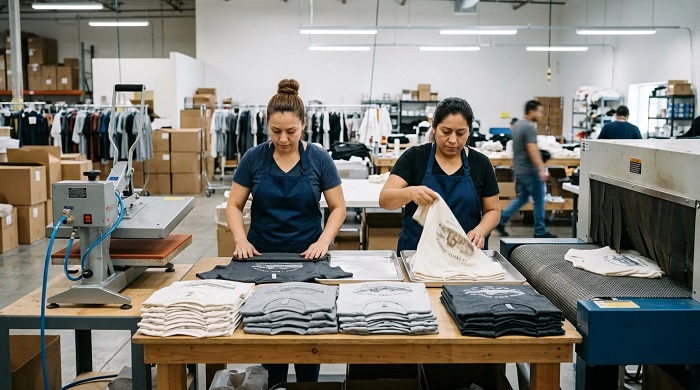
When apparel factories and high-volume custom print shops compare a dual-platen commercial direct-to-garment (DTG) printer against a single-platen machine, the core productivity gain lies in eliminating operator loading downtime: while a single-platen system sits idle every time an operator unloads a finished shirt and aligns the next blank, a dual-station platform allows garments to be loaded, smoothed, and unloaded concurrently with active ink jetting.
For garment manufacturers balancing rapid B2B sales sampling alongside daily production runs of fifty to several hundred cotton shirts, understanding how platen architecture interacts with operator motion and white-ink pass counts is essential before purchasing hardware.
Why Platen Loading Time Is the Hidden Bottleneck in Commercial DTG
In real-world garment decoration, a DTG printer’s brochure carriage speed tells only half the story; hourly output on the shop floor is governed by total cycle time—the sum of garment loading, collar alignment, wrinkle smoothing, active printing, and unloading to the conveyor dryer. On a single-platen DTG unit, even a fast print cycle is interrupted by thirty to六十 seconds of manual garment handling between every piece, meaning the printheads spend a significant fraction of each shift waiting for the operator.
A dual-platen industrial DTG architecture restructures that workflow into two parallel tracks:
- Overlapped loading and printing cycles: On asymmetric or shuttle dual-platen systems, the operator dresses Platen B while the carriage prints across Platen A; on twin-platen synchronous frames, two pre-treated garments enter the print zone per cycle, doubling batch density before the tray returns to the loading zone.
- Mixed-SKU and front/back pairing in one cycle: One platen can be configured for full-front chest artwork while the adjacent platen holds a sleeve, neck-tag, or youth-sized platen, letting a factory produce a complete multi-location retail sample in a single pass.
- Reduced white-ink idle intervals: Continuous back-to-back printing keeps titanium-dioxide white ink moving actively through the nozzles, reducing the frequency of mid-shift micro-purges compared with stop-and-start single-shirt loading.
Comparing Single-Platen and Dual-Platen DTG Workflows Across Shop Profiles
Choosing between a single-platen and a dual-platen commercial DTG machine depends on daily piece volume, staffing per station, and conveyor-dryer capacity.
| Operational Metric | Single-Platen Commercial DTG Printer | Dual-Platen Industrial DTG Printer | Production Planning Guideline |
|---|---|---|---|
| Printhead utilisation rate | Pauses between every single garment while the operator unloads and reloads | Minimises non-printing pauses by grouping or overlapping garment handling | Choose Dual-Platen when daily volume exceeds single-operator loading rhythm or requires shift-long batch output |
| Quick-response B2B sampling | Prints one size or one placement at a time | Can run front and back placements—or two colorway blanks—simultaneously in one cycle | Dual-Platen cuts merchandising sample turnaround for apparel brands evaluating multiple cotton shades |
| Downstream curing requirement | Can pair with a clamshell/drawer heat press or compact dryer for small volumes | Requires a continuous conveyor tunnel dryer (or dedicated multi-press curing station) to prevent a curing bottleneck | Never install a high-output dual-platen DTG printer without matching tunnel-dryer belt capacity |
| Operator ergonomics & staffing | One operator typically manages pre-press, loading, and heat-press curing for short runs | Best paired with pre-treated blank staging trays and direct hand-off onto a tunnel dryer belt | Standardise staging carts beside dual-platen machines so loading never falls behind the carriage cycle |
Aligning Pre-Treatment and Curing With Dual-Platen Output
Upgrading to a dual-platen DTG printer only translates into higher shipped volume if the upstream pre-treatment station and downstream curing line keep pace with the printheads. A common mistake in expanding print shops is placing a high-throughput dual-platen printer beside a single manual heat press used for both pre-treatment drying and final ink curing.
Because water-based DTG ink on dark cotton requires thorough moisture removal during both pre-treatment drying and final curing, forcing a single heat press to handle both tasks immediately stalls the printer. High-efficiency DTG rooms separate the line into three dedicated zones: an automated pre-treatment sprayer coupled with a dedicated pre-dry press or dryer channel, a pre-pressed garment buffer rack right beside the DTG dual platens, and a temperature-verified conveyor tunnel dryer with active exhaust at the unload end.
Selecting Multi-Head Dual-Platen DTG Equipment for Scalable Garment Production
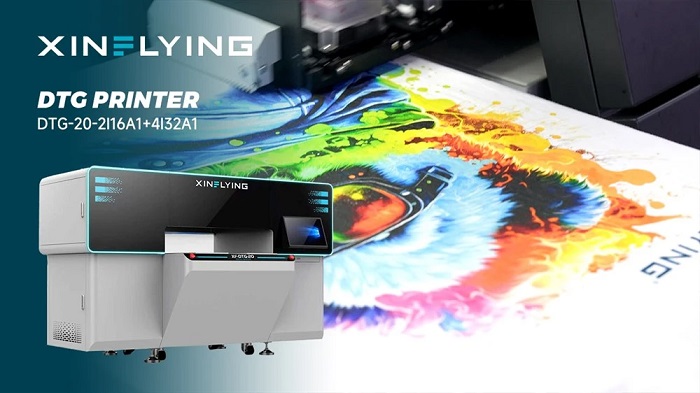
When an apparel factory or contract print shop needs industrial durability without stepping all the way up to a four-head line, a dual-head, dual-platen configuration offers a balanced step in capital efficiency and daily output. Production engineers evaluating dual-platen platforms such as the XINFLYING XF-DTG-20-2I16A1 (or scaling up to the four-head XF-DTG-20-4I32A1 system) can inspect the complete technical lineup of XINFLYING commercial DTG printing machines to compare printhead arrangements, white-ink circulation features, and platen dimensions.
By combining a dual-platen industrial platform like the XINFLYING XF-DTG-20-2I16A1 with staged pre-treated blanks and continuous conveyor curing, garment factories can compress B2B sampling lead times from days to hours while keeping small-to-medium cotton production profitable.
Hello!! My name is Jeanine
I love to eat, travel, and eat some more! I am married to the man of my dreams and have a beautiful little girl whose smiles can brighten anyone’s day!